
Context
The project: a financial social network (content plus a two-sided market). Before scaling, we needed to know which assumptions were the riskiest and which tests would give a signal fastest.
The task
- Write down the key assumptions (value, segments, content and authors, feed quality, monetization)
- Score each risk on P×I (probability × impact)
- Put together a test plan that quickly answers "keep going or change course"
What I did
- Listed the RAT assumptions and broke each one down by:
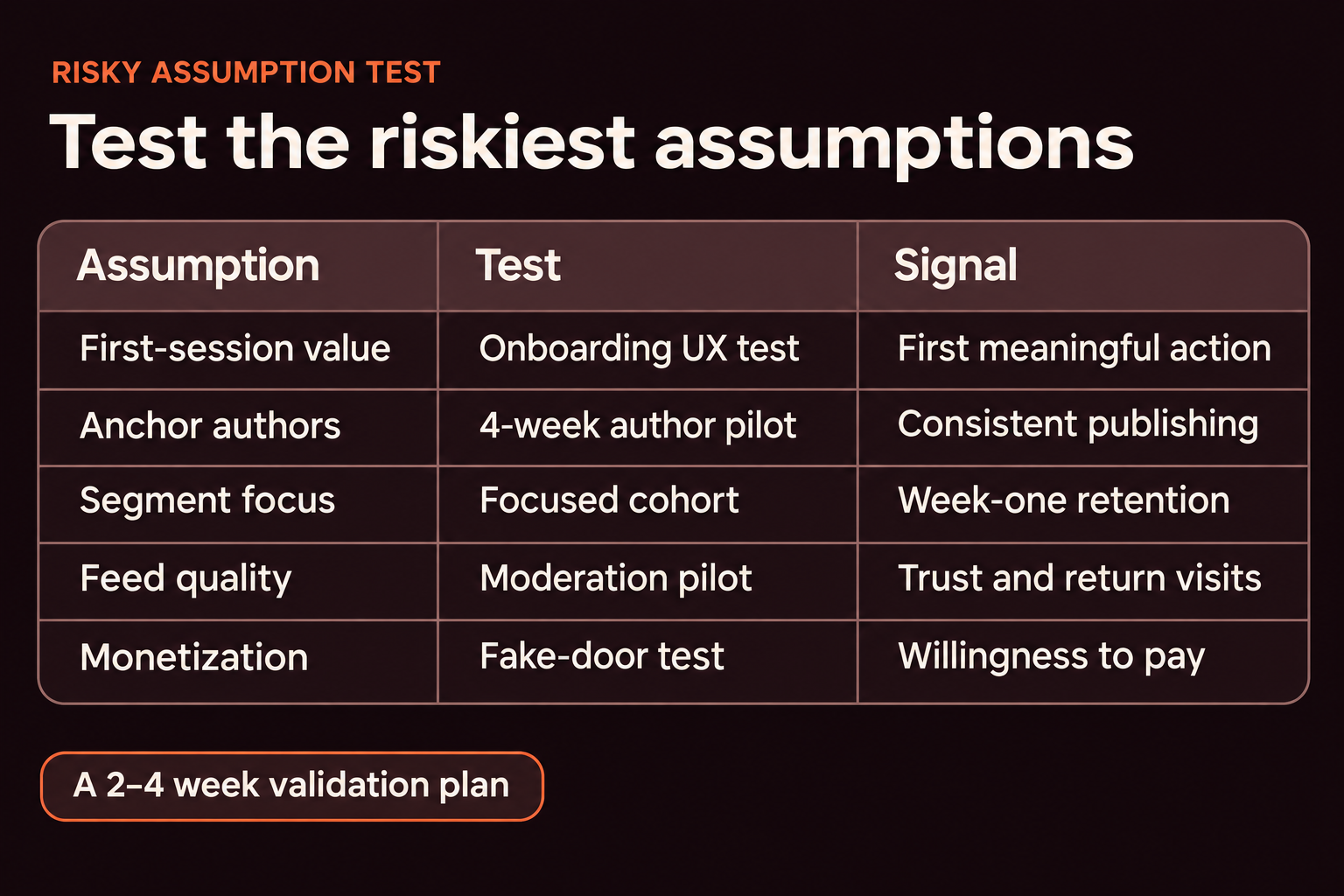
- Picked the top risks by score and described specific 2–4 week tests for each: interviews, UX tests, onboarding A/B tests, author pilots and "fake door" monetization tests.
Key risky assumptions (top 5)
- A successful first session: 35% of the focus segments reach a "first win" within 10 minutes (follows, saves, returning on D1/W1). If not, the product becomes "just another feed" and neither retention nor the economics work.
- Anchor authors: within 60 days it's possible to build a pool of active "anchor" authors who hold demand. Without them there's nothing to keep the audience or launch monetization with.
- Segment focus: choosing one primary segment drives W1/D30 growth. Without focus, the product is "about everything" and for no one.
- Feed quality: quality can be maintained with a low share of junk and spam. Otherwise trust and retention drop among conservative segments.
- Monetization that doesn't kill retention: after 12–18 months, ads or a subscription can be switched on with only a limited drop in D30. Otherwise you get growth without a business model.
How I tested it
- Interviews by segment and a breakdown of the first session (what gives "instant value")
- Onboarding UX tests on the critical sequence of actions in the first 10 minutes
- Quality control: a safe-mode feed, moderation and badges, and content audits
Results
- A prioritized RAT table (P×I, score, top risks)
- A 2–4 week test plan: what we test, how we measure it, and what threshold counts as success
- A clear go / no-go for scaling: either we prove first value and a content core, or we change the onboarding, focus or offer
My role
Growth consultant: framing the risk hypotheses, scoring them, designing tests and success metrics, and prioritizing the roadmap based on the RAT results.